

Maino and Akademiks were embroiled in a verbal and escalating back and forth. What began as a conversation about “teenior citizens” devolved into a coliseum of assault accusations. The sequence of events was simple. Akademiks poked fun at Jim Jones’, Maino and Fabolous’ fashion acumen. Before we could blink, Maino posted a video that brought into question both a lawsuit that was filed against Akademiks in May 2024 and an incredibly sexually inappropriate conversation the podcaster had with a 15-year-old.
The Brooklyn rapper used the behaviors as a thick yellow line that separated his lane from the podcaster’s. You could categorize it as a punch line, or the statement that makes the joke. The statement was in honor of the victims or to call attention to a deviant behavior that exists within the culture. It was reactive. Maino’s initial retort insulted Akademik’s physique (a jar of relish) and challenged his masculinity as defined by cultural standards. By Maino’s own admission, if Akademiks would have bowed out, he may not have shed light on such devious claims. But he didn’t, so the victims must be named.
Abuse as the ultimate gut punch.
The ability to use abuse as an upper cut feels taboo, but familiar. Kendrick Lamar and Aubrey “Drake” Graham used forms of abuse against women and young girls as the twisting knife, although Lamar’s was more financially successful. Family Matters framed Whitney, Kendrick’s longtime partner, as a domestic abuse victim who suffered at Kendrick’s hand. Throughout both “Meet the Grahams” and “Not Like Us”, Lamar alludes to predatory behavior within Drake’s camp with quips like “certified lover boys, certified pedophiles.” Even referencing it as a quip feels disingenuous, but I can’t deny the presentation. “Not Like Us” soared and Kendrick continued to mind the business that paid him. The video that showed a 23-year-old Drake’s interaction with a 17-year-old onstage in Colorado no longer did.
Curtis “50 Cent” Jackson’s intricate involvement in “The Reckoning”, a documentary that included intimate accounts of victims and former associates of Sean “P. Diddy” Combs, has been controversial from several angles. The accusations against 50 Cent and his reactions to recently named victims is enough to allow viewers to analyze the documentary as less exposition, more vendetta. Daphne Joy, one of the mothers of his children, has accused Jackson of rape and domestic violence as recently as 2024. The rapper even joked about her being named in Rodney “Lil Rod” Jones’ lawsuit as a sex worker that Diddy had conversations with him about.
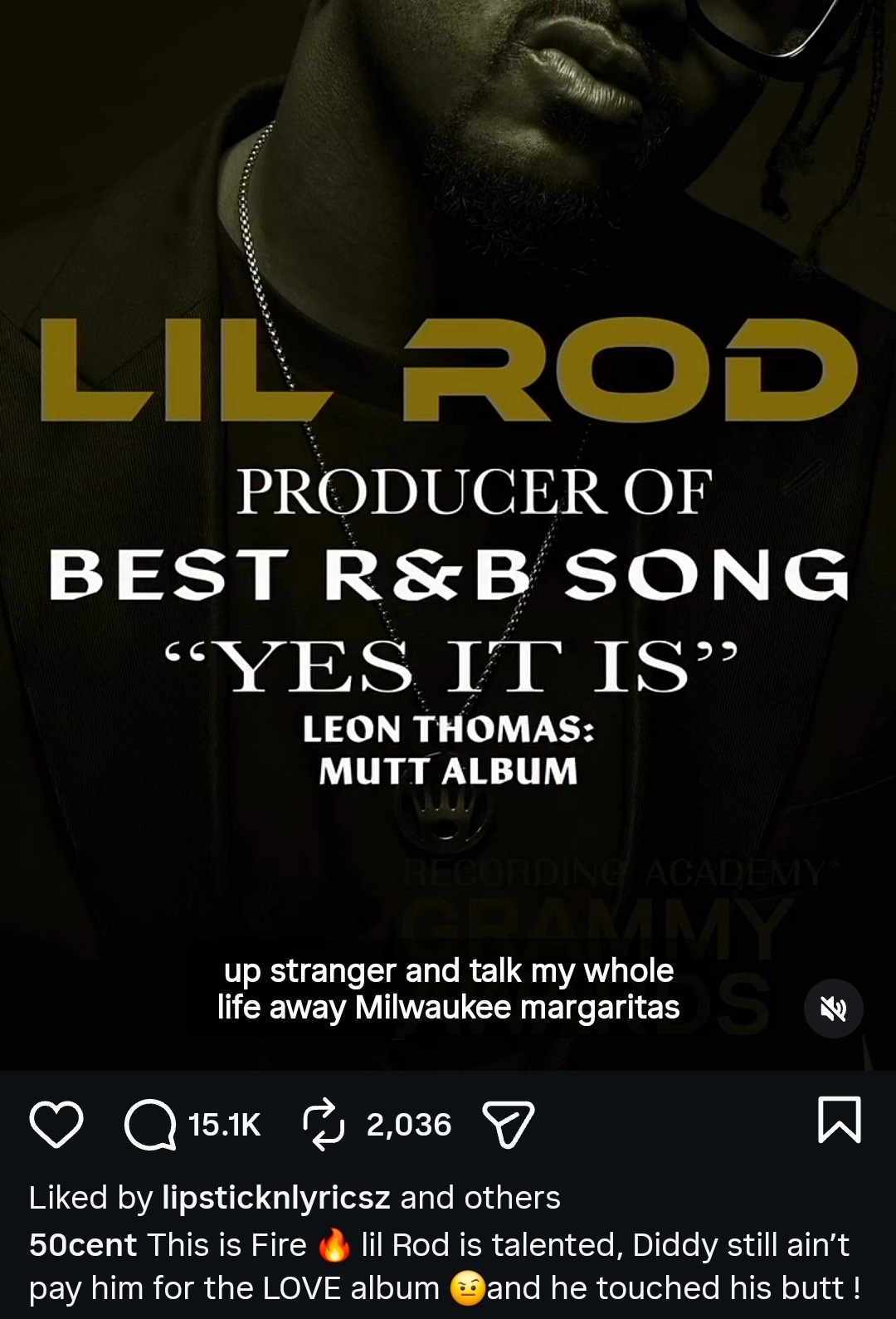
In 2025, 50 Cent congratulated Jones in an Instagram post for a Grammy nomination as a producer for Leon Thomas’ song “Yes It Is.” In the caption, Jackson wrote, “This is Fire. lil Rod is talented, Diddy still ain’t pay him for the LOVE album. And he touched his butt!” 50 Cent found himself publicly apologizing to Megan Thee Stallion for his participation in the online bullying she dealt with before and during the Tory Lanez trial. The concerns of whether or not he is a genuine advocate are not unfounded. While I was encouraged that someone with power in the industry made it a personal responsibility to “expose” Diddy’s ascension and the people that were abused on that path, I was uncomfortable that the conversation is controlled by someone who could see the victims at the punch line. It’s a culture that promotes blind advocacy for like-minded men and intolerance once that vitriol is spewed in-house, because the abuse alone is not egregious enough to excommunicate an ally.
Domestic Violence is always a bar.
Rarely, if ever, the woman or children in question are considered in the matter. Think back to “Drunk in Love” by Beyonce that featured JayZ. Let me refresh your memory.
Beat the box up, like Mike in ‘97, I bite
I’m Ike Turner, turn up baby, no, I don’t play
“Now eat the cake, Anna Mae
Said, “Eat the cake, Anna Mae
For the sake of completion, JayZ inserted the names of Mike Tyson and Ike Turner to demonstrate a specific level of sexual aggression. But, at whose expense? Mike Tyson’s violence extended outside of the ring and beyond the bite of Evander Holyfield’s flesh. Tyson, whose biography includes the description of a time he punched Robin Givens harder than any of his opponents, was accused of sexual assault by Erinn Cosby and was found guilty of rape in 1992 after the assault on Desiree Washington. The decision to include two men whose sexual deviancy and domestic violence has been acknowledged by their own admissions was a choice.
Ike Turner’s documented beatings of Tina Turner were an egregious reference to the intimacy between two loving partners. That’s not a symbol of passion. It was an unnecessary comparison that spiraled into some of the more memorable lyrics of the song. In honor of the culture, Tina Turner’s abuse has become a meme of two star-crossed lovers in a violent, yet sensational relationship and dismembers the brutal, life-threatening abusive reality of their love. It’s a dystopian parallel that while hip-hop capitalized off of lines such as “Eat the cake, Anna Mae”, Tina Turner endured nightmares triggered by the memories of the abuse she suffered at Ike’s hands.
The memeification of abuse.
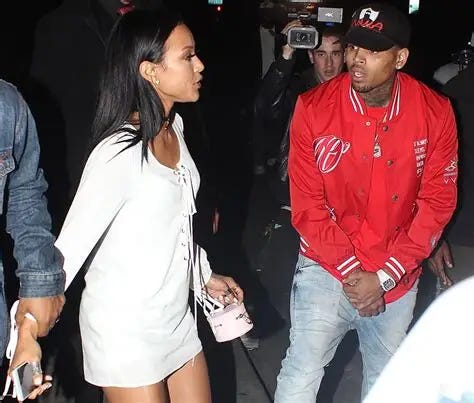
There was a meme that originated about a decade ago that depicted Chris Brown standing on a curb staring at model, actress and influencer Karrueche Tran in 2015. The internet interpreted the moment as a desperate attempt from a loving boyfriend to encourage a conversation with the object of his affection. It’s the object part that always gets me, right? Being the object of someone’s affection immediately strips the validity of your feelings of being pursued or loved upon. An object does not speak but is possessed. Social media ignored the seconds of the video where Karrueche’s friends tried to block Chris Brown as he forced his way into the vehicle. The follow-up report that police were called after he arrived at her residence behaving aggressively was just a blip in a much larger narrative of young and possibly toxic love. It altered the vantage point of Brown yelling Karrueche’s name in the middle of “Back to Sleep (remix)” that featured Zayn Malik and Usher, released in 2016.
The five-year restraining order that was granted against Brown in 2017 rightfully reforms the perception into abuse and control, a characteristic his audience was exposed to first in 2009 after his assault of Rihanna. Yet, when stories and lawsuits detail allegations of aggression and violence, these are not added to a history of evidence but treated as anomalies. Separate instances where there was a temporary lapse of judgment that was immediately course-corrected. These perspectives are presented even when those pivots are publicly proven to be unsuccessful. There doesn’t need to be atonement or culpability for an abuser to thrive in society. Only time and jokes.
Is the abuse a challenge to black excellence?
As I watched Dave Chappelle’s most recent Netflix special, “The Unstoppable”, he spoke about The Mann Act being used to stop Jack Johnson’s strides amongst the boxing elites and his public conquests with white women. Chappelle identifies The Mann Act, which is also named The White Slave Traffic Act, as a tool utilized to curb the upward advancement of Johnson’s career after he’d beaten white boxers and became the champion. Chappelle then makes sure to identify the parallels between “the unstoppable negro act” and Diddy’s sole count and conviction as a result of this law that was introduced in 1909 and codified in 1910. Specifically, The White Slave Traffic Act “made it a crime to transport women across state lines for the purpose of prostitution or debauchery, or for any other immoral purpose,” according to PBS. It was a broad stroke that proposed to address an increasing number of women who were being lured into immoral behavior and prostitution which George Kibbe Turner dubbed “white slavery.”
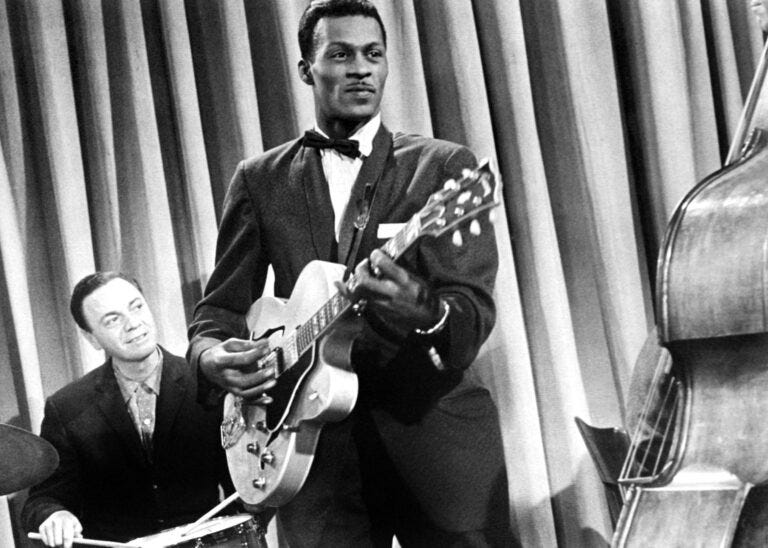
Chappelle’s reference to Johnson and the “unstoppable negro act” that the government successfully charged and convicted Diddy with missed a few moments of history. Another black entertainer that was charged under The White Slave Traffic Act was Chuck Berry, a pioneer of rock and roll music. In 1959, Berry was charged under the law for his transportation of 14-year-old Janice Escalanti across state lines. Berry’s intentions, according to the performer, was to hire the young girl to work the door at a nightclub he had recently opened because he felt sorry for her and she allegedly told Berry that was 21 years of age.
During this trial, he was acquitted of another White Slave Traffic Act case for his relationship with Joan Mathis, a 17-year-old he admitted to having a sexual relationship with at the time as Mathis confessed that she and the pioneer were in love. He was ultimately convicted in Escalanti’s case and was incarcerated. Charlie Chaplin, who married a 16-year-old at the age of 29 and another 16-year-old at the age of 35, was also charged with The Mann Act, but was not convicted. When Chappelle initially drew the parallel between Jack Johnson’s conviction of The White Slave Traffic Act and Diddy’s conviction under a similar statute, it was true, but incomplete. It was also a clear example of how the simplification of facts leads to the dilution of their severity. While Johnson’s conviction appeared racially motivated, Sean “Diddy” Combs was not simply overachieving for a black man. The details of the trial revealed deviance that deserves more than an alignment with a challenge to black excellence.
How does the culture course correct?
The way abuse is weaponized starts with a lack of information. If the culture aims to reset its approach to the misrepresentation of abuse and the dehumanization of victims, artists have to be culpable for their ignorance, as does the audience. The passive mentions of domestic violence or predatory behavior have to be met with sources and empathy. In an exemplary society, this challenge would be addressed with the appropriate platforms and conversations that centered victims as individuals with unwanted trauma and not the reason for their abuser’s misfortune. Yet, that community seems too small to matter.
As Doechii is harassed by Adin Ross and a streaming legion that often mimics the darkest arenas of dialogue, we have to examine how the dismissal of his jokes and disgusting commentary about Megan Thee Stallion’s abuse opened the door for this behavior. Until the artists of this generation become more responsible for their influence throughout the communities, they extract capital from, the conversations of abuse will continue to manifest a dangerous satire that feeds on a victim’s trauma. It’s a degradation of a culture that was founded on liberation and now breeds personalities manufactured to absolve it of its humanity.
Ikr! 💯